
2 April 2026
By Dani Wicklund
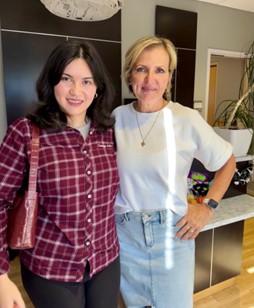
For this Women in STEM interview, we are featuring the incredible leader that is Dr. Dena Haritos Tsamitis. Like everyone, her story is unique. What makes her truly stand out is not only her accomplishments, but also the way she has uplifted others throughout her career.
Since 2004, Dr. Haritos Tsamitis has served as the director of the Information Networking Institute (INI), one of Carnegie Mellon University’s and the College of Engineering’s elite academic units that trains graduate engineers through technical, interdisciplinary master’s degree programs. Throughout her tenure, she has grown the INI from one degree program to five, established the first Carnegie Mellon degree programs to be offered at global locations and created partnerships with government and industry collaborators that lower financial barriers and provide meaningful mentorship to INI students. She leads with impact and is building the future of cybersecurity education through empathy, integrity, and hope.
Career Trajectory
Danielle: Director Dena, can you please share your professional journey?
Dena: After I completed my bachelor’s degree in Information Science, I went on to become a systems analyst with Eli Lilly and Company in Indianapolis, Indiana. At the time, Eli Lilly had around 30,000 employees across 120 countries, so there was a need for a way to better share information internally. I helped design the company’s first intranet site, which then grew into a vehicle for workforce education and training.
This was in the early days of the World Wide Web, when most people hadn’t heard of the internet. I felt very lucky to see the digital revolution begin.”
Dena: Initially at CMU, I built on my experience using technology to help improve education as an instructional technology design consultant. I worked with deans, department heads and individual faculty across the university - my team led CMU’s rollout of Blackboard, the learning management system.
Former Director of the INI Pradeep Khosla hired me as a consultant to help design the university’s first global degree program in Athens, Greece. It was such a success that he brought me on as associate director of the INI in 2002. This was a period of major development at CMU, and I was right in the middle of exciting changes. I am a founding director of CyLab, CMU’s security and privacy institute, and during this time I spearheaded our efforts to expand cybersecurity education through the MySecureCyberspace initiative. This online game and curriculum, which was launched in 2005, reached over one million people across 167 countries, helping them learn how to navigate the internet safely through the Carnegie Cyber Academy and Game. I also launched the INI’s information security degree, the M.S. in Information Security, which has been one of the leading cybersecurity engineering degrees for the past two decades and is now the number one ranked program.
Advice
Highlight: “We all have our unique superpowers.”
Danielle: What advice would you offer to young women who want to further their careers in STEM and have imposter syndrome holding them back?
Dena: I think everybody, to some degree and some point in their lives, experiences this. Imposter syndrome is a phenomenon that, despite my accomplishments or my background, I feel that I simply don’t belong in this opportunity, I was selected by accident, or I’m not as good as they think I am. We all confront that at some point in our lives. It is important that we talk ourselves out of it.
So, I remind myself about the challenges I’ve overcome in the past or things I’ve accomplished, which I call my greatest hits. I remind myself that I’m smart, I’m intelligent, I’m driven, I’m a hard worker and I have what it takes. I’m no different than the other person in the room. We’re all different. We all bring different things to the table, so I don’t compare myself to other people. I think we’re all unique. And that’s what is really important - we all have our unique superpowers.
Challenges
Highlight: “Hope guided me. And this is how I lead: with hope.”
Danielle: What challenges do women face in STEM and how can organizations better support them?
Dena: I think women bring extraordinary attributes to STEM. Organizations need to leverage women’s unique attributes and build workplace cultures and practices that support employees of all backgrounds and experiences.
I bring who I am every day I show up in my role here at Carnegie Mellon. I am a woman. I am a mother. I am a grandmother now. I was a daughter. I’m the matriarch in my family since my mother passed away. I personally had to overcome health challenges, and I did all of this with hope. Hope guided me. And I instill that into the people I work with or people who work for me. If there’s a will, there’s a way. And that’s how I do it as a woman.
Best Practices
Highlight: “I help others talk themselves out of self-doubt.”
Danielle: Reflecting on those challenges that we’ve discussed, especially how you try to bring hope to others and to yourself, what other best practices have you cultivated to overcome those challenges?
Dena: When students come to me and they are doubting themselves or they’re having challenges, I guide them through conversation. I don’t tell them that they’re capable. I ask questions that lead to them answering and seeing and believing in themselves, because of the way that they answer those questions. I help others talk themselves out of this self-doubt.
Skills and Mindsets
Danielle: Director Dena, based on your experience, what skills and mindsets do you think are essential for women aiming for leadership roles in the field of cybersecurity?
Dena: Number one is authenticity and believing in yourself. Sometimes, young people discount the need for EQ (Emotional Quotient). If you look at the INI’s curriculum, there are all of these technical courses. So, why did the INI create a new course called Academic and Professional Development? Because there are so many essential skills (some people call soft skills - I call them essential skills) that people are lacking out in the field, like conflict resolution or leading with empathy.
One of the sessions is on academic integrity. And it’s not just about integrity as a student, but ethics and integrity in the workplace. We also talk a lot about communication skills and teamwork, because you need to be able to collaborate effectively to build a thriving career. All of these things are important. Students are so focused on the technical aspects of courses that they miss out on these opportunities to develop these life skills that will serve them well not only when they’re students, but when they’re in the workplace and in their personal lives.
Anyone who dreams of being a leader in this space needs to not only have exceptional technical skills and savvy; they also need to be able to inspire others and lead with authenticity. Every person has something to offer, so it’s about figuring out what drives you and how your skills can create positive change.